Agency Google Ads: Expert Guide for Local Businesses
Finding the right approach to online advertising can feel overwhelming, especially when you're running a local business and trying to compete for customers in your area. Agency Google Ads services have become increasingly popular in 2026, offering businesses professional management of their paid search campaigns whilst they focus on delivering excellent service to their customers. Whether you're a tradesperson, retailer, or service provider, understanding how agencies structure and optimise Google Ads campaigns can help you make informed decisions about your marketing budget and strategy.
What Agency Google Ads Services Actually Include
When you partner with an agency for Google Ads management, you're accessing a range of specialist skills and ongoing campaign optimisation that would be challenging to replicate in-house.
Most comprehensive agency Google Ads packages include several core components. Campaign structure and setup forms the foundation, where specialists create properly organised account hierarchies that align with your business goals. This includes establishing campaigns, ad groups, and keyword themes that follow Google Ads account structure best practices to ensure your campaigns perform efficiently from day one.
Core Agency Responsibilities
- Keyword research and selection based on search volume and commercial intent
- Ad copywriting and creative development tailored to your audience
- Bid management and budget allocation across campaigns
- Landing page recommendations to improve conversion rates
- Performance tracking and monthly reporting
- Ongoing testing and optimisation based on data
Budget management represents another critical service area. Agencies monitor your spending daily, adjusting bids to maximise your return on investment. They'll shift budget towards high-performing keywords and away from underperformers, something that requires constant attention and expertise.
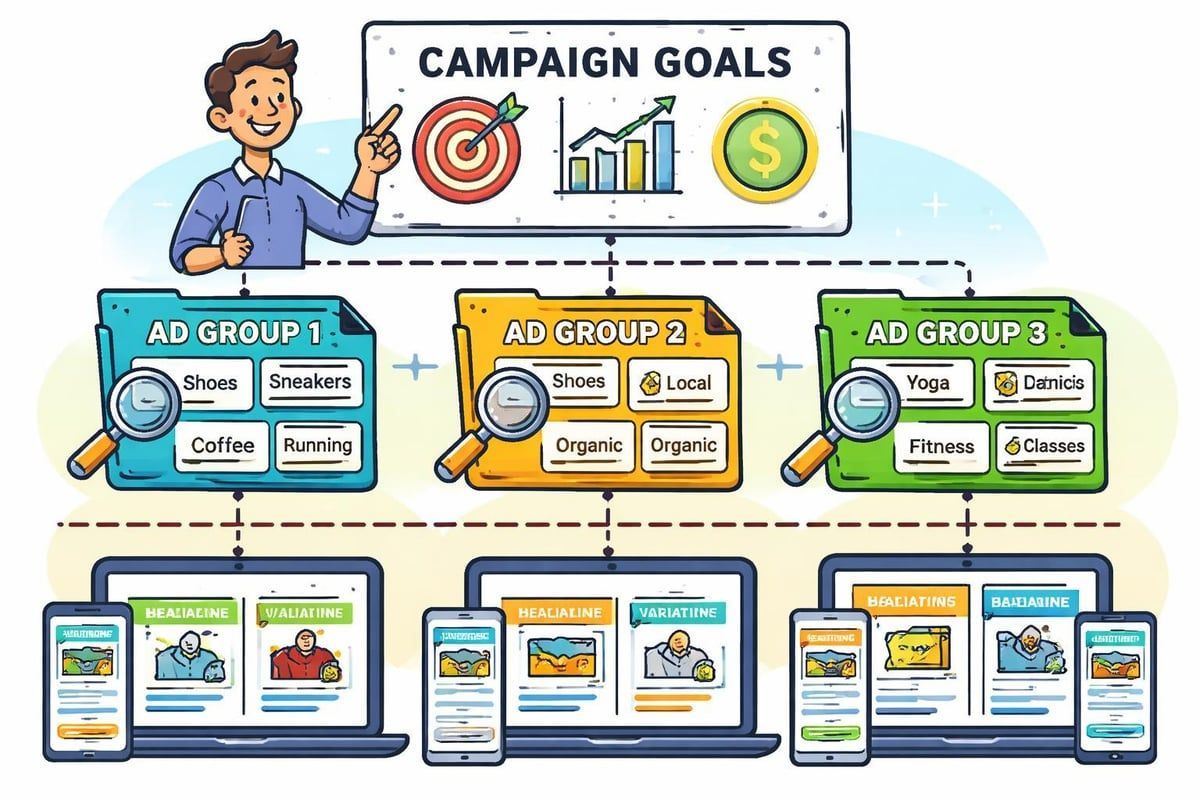
The reporting component keeps you informed without overwhelming you with data. Quality agencies translate metrics into actionable insights, showing you which campaigns drive phone calls, form submissions, or shop visits.
How Agency Google Ads Differs From DIY Management
Running your own Google Ads account might seem straightforward initially, but there's a substantial difference between setting up ads and managing profitable campaigns.
Time investment is the first major distinction. PPC advertising management requires daily monitoring, weekly optimisation, and monthly strategic reviews. Most business owners simply don't have 10-15 hours per week to dedicate to campaign management whilst also running their operations.
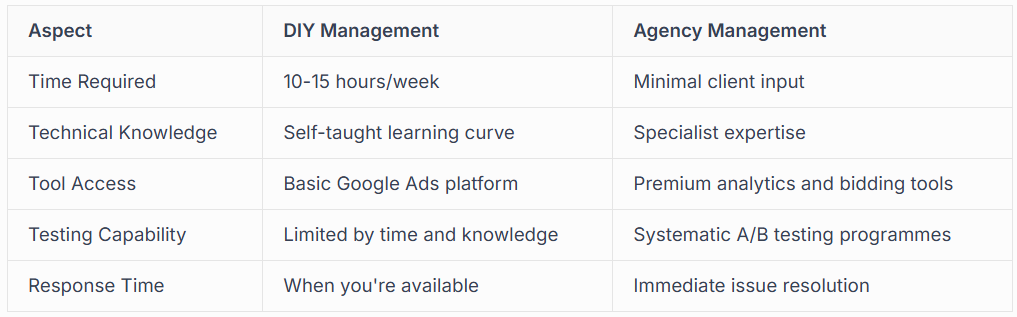
Expertise depth separates amateur from professional campaign management. Agencies work across dozens of accounts simultaneously, seeing patterns and opportunities that single-account managers miss. They understand Google advertising rates across different industries and can benchmark your performance against competitors.
Risk mitigation is another key advantage. Google's advertising policies are complex and constantly evolving. Policy violations can result in account suspensions that halt your lead generation overnight. Agencies stay current with policy changes and implement compliant strategies from the start.
Technology and Tools
Professional agencies use sophisticated tools beyond the standard Google Ads interface. These include advanced bid management platforms, heat mapping software, call tracking systems, and customer relationship management integrations that reveal the complete customer journey.
Understanding Agency Google Ads Pricing Models
Transparency around costs helps you budget appropriately and evaluate agency proposals effectively.
Most agencies structure their fees using one of three primary models. Percentage of spend remains the most common approach, where agencies charge 10-20% of your monthly ad spend. If you invest £2,000 in ads, you'd pay £200-£400 in management fees. This model scales with your investment and aligns agency incentives with campaign growth.
Flat monthly retainers offer predictable costs regardless of ad spend fluctuations. These typically range from £500 to £5,000+ monthly depending on campaign complexity and the scope of services provided. This model suits businesses with stable budgets who value consistent service levels.
Performance-based pricing ties agency compensation to specific results like leads generated or revenue attributed to campaigns. Whilst this sounds attractive, it's less common because external factors (your sales team, website quality, product pricing) significantly influence conversion rates beyond the agency's control.
What Influences Agency Fees
- Campaign complexity (number of products/services advertised)
- Industry competitiveness and average cost-per-click
- Geographic targeting scope (local vs. national vs. international)
- Integration requirements (CRM systems, phone tracking, etc.)
- Reporting frequency and detail required
- Additional services like landing page design or conversion rate optimisation
Setup fees are sometimes charged separately, ranging from £500 to £2,500, covering initial account architecture, keyword research, and ad creation. These one-time costs lay the groundwork for ongoing success.
When evaluating agency Google Ads pricing, compare like-for-like services. A low monthly fee might exclude essential services like conversion tracking setup or regular performance reviews that deliver actual business value.
Selecting the Right Agency Google Ads Partner
Choosing an agency requires looking beyond impressive case studies and persuasive sales presentations.
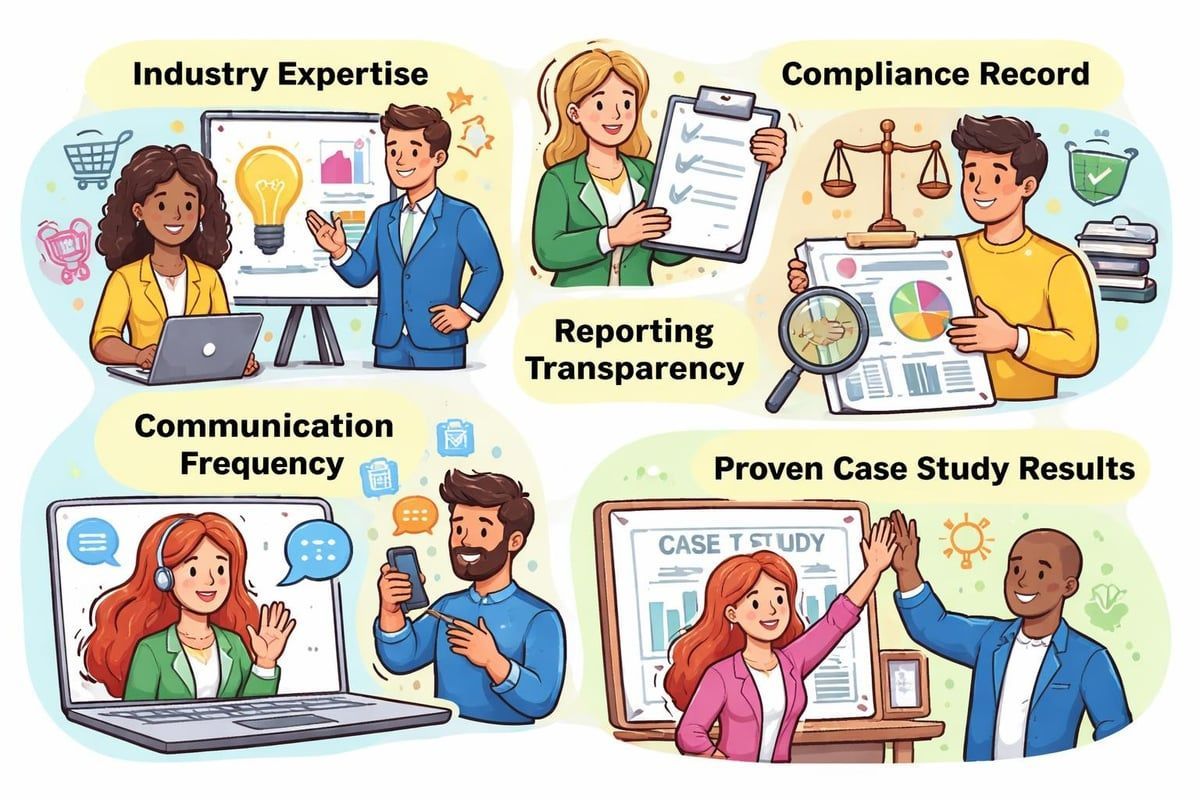
Compliance and account safety should top your evaluation criteria. Selecting a Google Ads agency means ensuring they follow Google's advertising policies rigorously. Ask potential agencies about their experience with account suspensions and how they prevent policy violations.
Relevant industry experience matters tremendously. An agency that's successfully managed campaigns for tradespeople, for instance, understands seasonal demand fluctuations, local service areas, and the types of keywords that indicate genuine buying intent versus research browsers. At Connect SEO, our founder's background as a tradesman who scaled his own business provides firsthand insight into what local service businesses actually need from their advertising.
Questions to Ask Potential Agencies
- What specific experience do you have in my industry?
- How do you structure campaigns for local service businesses?
- What conversion tracking systems do you implement?
- How frequently will we communicate, and what reporting will I receive?
- Who will actually manage my account day-to-day?
- What happens if my account gets suspended or flagged?
- Do you guarantee account ownership remains with me?
- What's your approach to budget testing and scaling?
Communication style and frequency significantly impact your experience. Some agencies provide weekly updates, whilst others communicate monthly unless issues arise. Establish expectations upfront to avoid frustration later. You want an agency that explains strategy in plain English rather than hiding behind jargon.
Account ownership deserves explicit discussion. You should always own your Google Ads account and have full access. Agencies should be granted management permissions, but the account itself remains your business asset. If you part ways with an agency, you keep your account history and can transition to a new partner seamlessly.
Agency Google Ads Strategies That Drive Local Results
The most effective agency Google Ads campaigns for local businesses employ specific tactics that maximise visibility where it matters most.
Location targeting goes beyond selecting a city or postcode. Smart agencies create campaign structures that allow different bids for your core service area versus peripheral areas. They might bid more aggressively for searches within 5 miles of your business whilst maintaining presence in a broader 20-mile radius at lower bids.
Call extensions, location extensions, and message extensions become crucial for local campaigns. These make it effortless for potential customers to contact you directly from search results. Agencies configure call tracking so you can measure which keywords generate phone enquiries, not just website clicks.
Campaign Types for Local Businesses
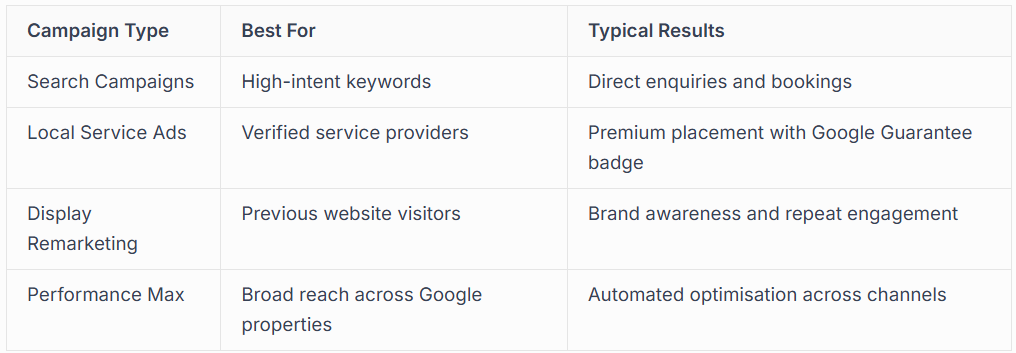
Ad scheduling aligns your visibility with your availability. If you're a tradesperson who doesn't answer calls after 6pm, agencies can reduce or pause ads during evening hours, saving budget for when you can actually respond to enquiries. This simple tactic often improves conversion rates whilst reducing wasted spend.
Negative keyword lists prevent your ads from appearing for irrelevant searches. An agency managing Google Ads campaigns for trades would exclude terms like "DIY", "how to", or "jobs" to avoid clicks from people wanting to do the work themselves or seeking employment rather than hiring your services.
Integration with Google Business Profile
The connection between Google Ads and your Google Business Profile amplifies local visibility. Agencies ensure your profile information is complete and accurate, as ads can display your business hours, photos, and reviews directly in search results.
For businesses still working to establish their local presence, Google Business Profile verification creates the foundation that makes your ads more effective. Without verification, your business won't show in Google Maps, and you'll miss opportunities to appear in local pack results even when running paid campaigns.
Measuring Agency Google Ads Performance Effectively
Understanding which metrics actually matter helps you evaluate whether your agency delivers value or simply spends your budget.
Cost per acquisition (CPA) represents the ultimate measure of campaign efficiency. This shows exactly how much you're paying to acquire each customer. If your average customer lifetime value is £500 and your CPA is £50, you've got a profitable channel worth scaling. Agencies should track CPA religiously and work to reduce it over time through optimisation.
Click-through rate (CTR) indicates how compelling your ads are to searchers. Higher CTRs generally mean better ad relevance and quality scores, which in turn reduce your costs. Data-driven Google Ads strategies focus on continuous improvement of CTR through ad copy testing and refinement.
Conversion rate measures how effectively your landing pages turn clicks into leads or sales. If you're getting plenty of clicks but few conversions, the issue lies with your website rather than the ads themselves. Quality agencies diagnose these problems and recommend solutions.
Metrics That Matter Less Than You Think
- Impressions (seeing your ad doesn't generate revenue)
- Overall account quality score (individual keyword scores matter more)
- Number of keywords (quality over quantity always wins)
- Position (being #1 isn't cost-effective if #2 or #3 converts just as well)
Return on ad spend (ROAS) expresses campaign profitability as a ratio. A 5:1 ROAS means you generate £5 in revenue for every £1 spent on ads. Understanding Google Ads costs in relation to the revenue generated helps you make informed scaling decisions.
Attribution windows affect how agencies report results. Did that customer convert within hours of clicking your ad, or did they research for weeks before booking? Agencies should explain their attribution methodology so you understand what's being measured.
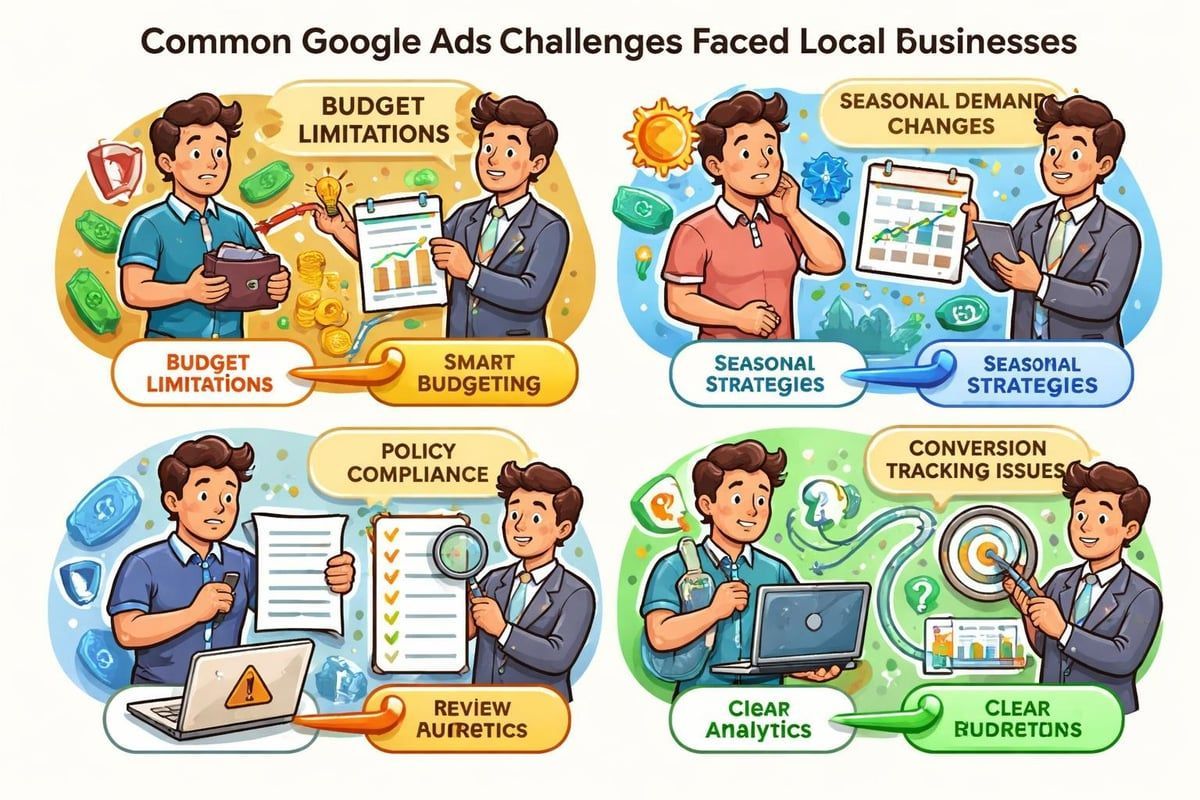
Common Agency Google Ads Challenges and Solutions
Even well-managed campaigns encounter obstacles that require specialist knowledge to overcome.
Seasonal demand fluctuations affect many local businesses. Landscapers face quiet winters, whilst heating engineers experience summer lulls. Smart agencies don't simply pause campaigns during slow periods; they adjust budgets, shift to brand awareness objectives, and capture early-stage searchers at lower costs who'll convert when demand returns.
Budget constraints limit testing and scaling opportunities. When you're working with £500-£1,000 monthly budgets, agencies must be extremely selective about which keywords and campaigns receive funding. They'll focus on high-intent, bottom-funnel keywords that drive immediate enquiries rather than broader awareness campaigns that require larger budgets to show returns.
Handling Account Issues
Policy compliance challenges emerge regularly as Google updates its advertising requirements. Recent changes around identity verification, advertiser disclosure, and service-specific regulations (particularly for healthcare, finance, and home services) mean what worked last year might violate policies today. Agencies tracking these changes protect your account from preventable suspensions.
Case studies from UK Google Ads campaigns demonstrate how agencies overcome industry-specific challenges. For instance, highly regulated sectors like locksmiths face additional verification requirements that agencies familiar with these industries navigate efficiently.
Advanced Agency Google Ads Techniques for 2026
The advertising landscape continues evolving, and leading agencies implement cutting-edge strategies that separate good campaigns from exceptional ones.
Smart Bidding strategies use machine learning to optimise bids in real-time based on numerous signals. Target CPA bidding automatically adjusts your bids to achieve your desired cost per conversion, whilst Target ROAS maximises conversion value within your budget. These require sufficient conversion data to function effectively, typically 30-50 conversions monthly as a baseline.
Agencies implementing conversion tracking and A/B testing systematically improve campaign performance over time. They'll test different ad headlines, description variations, landing page layouts, and call-to-action buttons to identify what resonates most with your audience.
Audience layering techniques
- In-market audiences (people actively researching your services)
- Custom intent audiences (based on specific keyword and URL behaviour)
- Customer match (uploading your existing customer list)
- Similar audiences (finding people who match your best customers)
Performance Max campaigns represent Google's newest campaign type, automating ad delivery across Search, Display, YouTube, Gmail, and Discover simultaneously. Whilst this reduces manual control, it often outperforms traditional campaigns by finding conversion opportunities across channels you might not have prioritised.
Responsive search ads have become the standard ad format, allowing agencies to provide up to 15 different headlines and 4 descriptions. Google's algorithm tests various combinations to identify which messages perform best for different searches and users, continuously optimising without manual intervention.
Integrating Agency Google Ads with Broader Marketing
Paid search doesn't exist in isolation; the most successful strategies connect agency Google Ads with other marketing channels.
Local SEO and Google Ads work synergistically for local businesses. Whilst Google Business Profile management improves your organic visibility in local pack results, Google Ads ensures you appear at the very top of search results for competitive keywords where organic rankings take time to achieve.
Running both simultaneously accelerates results. Organic efforts build long-term sustainable visibility, whilst paid campaigns deliver immediate enquiries. Data from Google Ads campaigns informs organic keyword targeting, showing which terms have commercial intent worth pursuing through content creation and SEO optimisation.
Content marketing supports paid campaigns by providing relevant landing pages for different services and customer questions. Rather than sending all ad traffic to your homepage, agencies create dedicated landing pages for specific services (emergency plumbing, boiler installations, bathroom renovations) that match searcher intent precisely.
Cross-Channel Attribution
Understanding how customers interact with multiple touchpoints before converting helps allocate budget effectively. Someone might first discover your business through a Google Ad, visit your website, then see display remarketing ads, check your Google Business Profile reviews, and finally call you directly. Agencies use attribution modelling to value each interaction appropriately rather than crediting only the final click.
Social media advertising complements Google Ads by building awareness and retargeting engaged audiences. Whilst Google captures active searchers, Facebook and Instagram ads reach people who might not be actively searching but fit your ideal customer profile based on demographics, interests, and behaviours.
The Future of Agency Google Ads Management
Looking ahead through 2026 and beyond, several trends are reshaping how agencies manage Google Ads for local businesses.
Automation and AI continue expanding, handling more optimisation decisions previously requiring human intervention. This doesn't eliminate the need for agencies; instead, it shifts their value from manual bid adjustments to strategic direction, creative development, and interpreting automated system outputs.
Privacy changes following cookie deprecation force agencies to rely less on third-party tracking and more on first-party data collection. This makes conversion tracking setup and customer data platforms increasingly important for campaign success.
Emerging Opportunities
- Voice search optimisation for conversational queries
- Video ads targeting local audiences on YouTube
- Integration with booking and scheduling platforms
- Enhanced local inventory ads for retailers
- Augmented reality ad formats for visualising services
Sustainability and transparency in advertising are becoming customer expectations. Agencies that clearly communicate where ads appear, how budgets are allocated, and what results are actually attributable to their efforts will differentiate themselves from those relying on vague reporting and industry jargon.
The relationship between verification, local visibility, and paid advertising is strengthening. Businesses with verified Google Business Profiles enjoy higher Quality Scores in Google Ads, leading to lower costs and better ad positions. This integrated approach to local online presence becomes essential for competitive industries.
Agency Google Ads management offers local businesses professional expertise, time savings, and typically better returns than DIY approaches, particularly when campaigns are integrated with strong local SEO foundations. Whether you're looking to scale your advertising or simply need your Google Business Profile verified to appear in local searches, Connect SEO Ltd combines hands-on trade experience with digital marketing expertise to help your business get found by customers who need your services. As a UK-based team founded by someone who built their own business through local search, we understand both the technical requirements and the practical realities of running a successful local operation.